Collection Development
The purpose of this collection was to develop 5 adaptive garments catered towards a particular group of individuals with a disability of our choosing. Background research was conducted with our target market, trough interviews and questionnaires, to find consumers needs and worries in order to address them and solve them within our designs.
Brand Name
VICE VERSA
Vice Versa is defined as "the other way around" and clothing should not be designed for one particular group of people. Vice Versa as a brand creates clothing for individuals to express who they are and want to be seen as. Not conforming to stereotypes or society norms always standing out and being Vice Versa of what the fashion industry is today.

IMAGE REFERENCES (LEFT TO RIGHT): @COMPLEX.COM, @SOBERYYOUNGWALTER, @THEINTERNETOFFICE, @RAFAMERICORAFA_, @SHAHDBATAL, @IGNANT_PHOTOGRAPHY, @FORT MAGAZINE, @WILLIAMJOEL
Mood Board
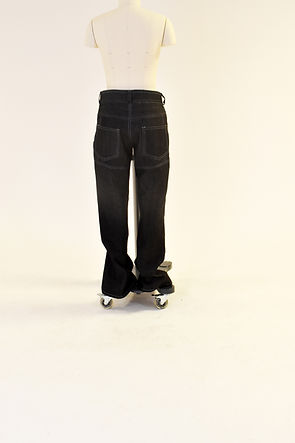
The garment I chose to prototype was the Baggy Denim Jeans. I wanted to challenge myself by altering an existing pattern and adding flare to a pair of denim jeans. First constructing the way to see the fit of it, and later altering the patterns and constructing a final garment. By adding width to each leg panel, I was able to achieve the same design features in my initial flat prototypes and created a successful unisex garment. A 100% Balenciaga Cotton denim was used to construct the garment with contrasting white stitching. A silver button and metal zipper were used for the front closures. Laser engraved logo below left pocket. The prototype process was successful through each stage of the initial prototype, pattern alterations, and final prototype.
Prototyping Process
Prototyping Phases
Phase One: Initial Garment Construction
For the first part of the prototyping phase, a block pattern was sourced for a straight pair of men's jeans. Following the patterns information, I constructed a men's size 36 waist X 34 length out of denim prototyping fabric. When prototyping this initial garment I wanted to use a fabric that was similar to my final prototype to see the drape of a similar fabric for this style. Overall I was able to gain an understanding of the processes to construct a pair of denim jeans and planned out where I would make my alterations within the pattern pieces.


Phase Two: Pattern Alterations
The second phase was focusing on altering the block patterns to achieve a more baggy fit and adjusting the sides to fit more female-type body shapes. The back panel seams were also put together to limit the amount of bulge in some sections. The initial pattern was digitally translated and in this phase, I am combining pattern pieces and altering them to add flare and a baggy fit to the initial pattern blocks.


Phase Three: Final Prototype
The final phase of my prototyping process was creating the final prototype. The fabric used for this garment was Balenciaga Italian Black Stiff Cotton Denim. After altering the pattern in phase 2 I was pleased with the drape and the stiff cotton denim produced a nice stack for the jeans. Contrast white stitching that was used as decorative front pockets. A metal Button and zipper were used for the front closure.